Business trips
Business trips are also part of everyday university life at OVGU—they are important for research, teaching, and collaboration. At the same time, they account for a significant portion of OVGU's CO2 emissions. In addition to travel distance, the choice of transport plays a particularly important role in determining a trip’s climate impact.
In 2023, OVGU's business trips generated approximately 1,475 tons of CO2 equivalents. The greenhouse gas emissions of various distance classes were composed as follows:
Greenhouse gas emissions (THG) by distance class (DK). As of December 2024.
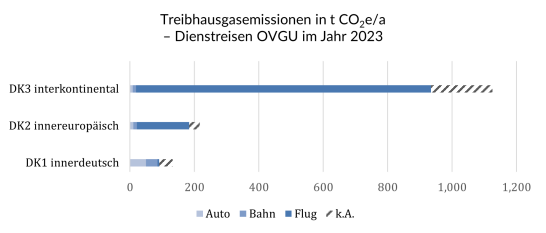
(DK1: within Germany; DK2: within Europe; DK3: intercontinental)
(means of transport (from left to right): car, train, airplane, no information)
How can I make my business trip more sustainable?
To support more sustainable decisions, we would like to offer a small decision guid for different travel situations:
-
Intercontinental business travel
For intercontinental journeys, flying is usually the only realistic option. This makes it all the more important to reflect in advance: Is the trip really necessary? In some cases, participating in conferences or meetings online can be a good and much more climate-friendly alternative. -
Intra-European business travel
For travel within Europe, the Travel Decision Map can help with choosing a suitable mode of transport. It shows which destinations can be reached conveniently and within a reasonable travel time by train – and where switching from plane to rail can make a real difference. -
Domestic business travel (within Germany)
For travel within Germany, trains are generally the most sustainable option and a good alternative to cars or flights.
Our shared guiding principle is simple: Every tonne of CO₂ counts. Even small, conscious choices can help make business travel more climate-friendly – without giving up exchange and collaboration.
The Travel Decision Map
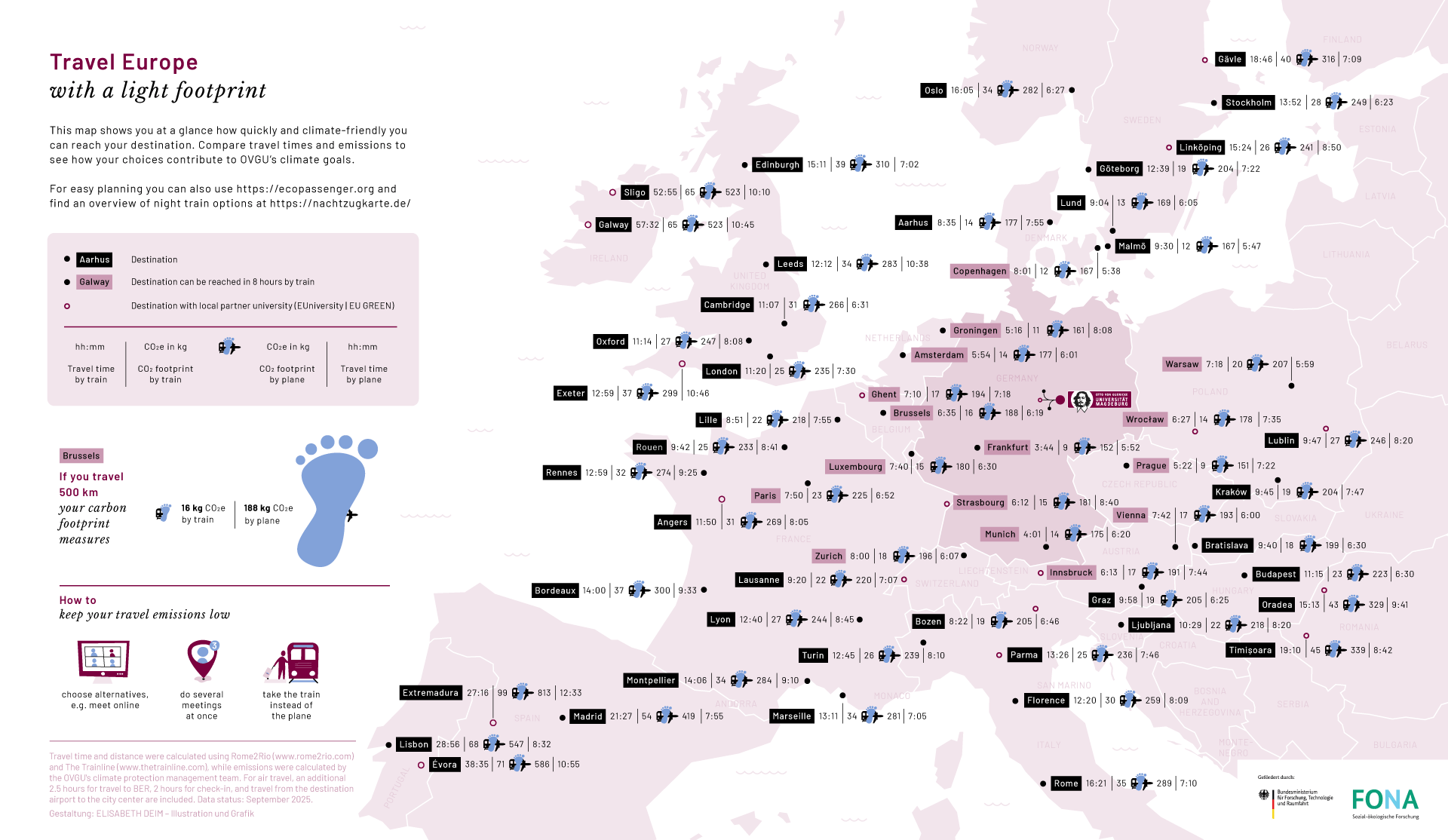
To show how the Travel Decision Map can support more sustainable decisions, it is helpful to look at a concrete example: a business trip to Brussels: When travel to and from the airport as well as planned waiting times are taken into account, the total travel time by train and by plane differs only slightly. The journey takes approximately 6 hours and 35 minutes by train, compared to 6 hours and 19 minutes by plane. The difference becomes clear when looking at greenhouse gas emissions: travelling by train results in around 16 kg of CO₂ equivalents, while flying causes approximately 188 kg of CO₂ equivalents.
In this case, switching to the more sustainable mode of transport – the train – clearly makes sense.
Useful links:
- Plan your travel: https://ecopassenger.org
- Travel with night trains: https://nachtzugkarte.de
Note:
Tarvel Map was created as part of the KlimaPlanReal project, with the participation of Andreas Grahn (K25), Prof. Daniel Juhre (FMB), Prof. Thomas Richter (FMA), Prof. Astrid Seltrecht (FHW), Prof. Armin Dadgar (FNW), Andreas Deuß (FNW), Dr. Silke Rühmland (Sustainability Office), and Dr. Christian Künzel.